Welcome to Digital Change Makers
👋 Welcome!
You are about to begin an 8-week journey to become a Digital Change Maker — someone who can think critically about media and create powerful stories using a smartphone.
This course is practical. Every week, you will make something real — not just take notes. By Week 8, you will publish a final story in our Online Exhibition Showcase.
What you will learn in this course
By the end of this program, you will be able to:
- Create stories using photos, audio, and video with your phone
- Plan stories using story circles, pitching, scripts, and storyboards
- Improve your work through peer feedback using SAMS (Story, Audience, Message, Style)
- Identify bias, misinformation, and credibility signals in online content
- Tell stories safely using consent, privacy, and respectful representation
- Publish your work responsibly with a simple distribution plan
How each week works
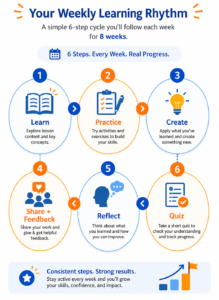
Each week follows the same rhythm, so you always know what to do:
- Learn – Short lessons you can complete in small steps
- Practice – Quick activities to try the skill immediately
- Create – One weekly output such as a storyboard, photo essay, audio story, or video
- Share + Feedback – You will give and receive feedback using SAMS
- Reflect – A short reflection on what you learned and what to improve
- Quiz – A short quiz to check understanding and track progress
What you will create across 8 weeks

- Week 1: Media Map + “My Voice” story seed + SAMS analysis
- Week 2: Pitch + storyboard
- Week 3: Photo essay
- Week 4: Audio story
- Week 5: Video sequence + shot list
- Week 6: Rough cut + revision plan
- Week 7: Distribution plan + campaign asset
- Week 8: Final cut + artist statement + exhibition card
Tools you need
You can complete this course using:
- A smartphone with a camera
- Earphones or a headset for clearer audio
- A simple editing app such as CapCut, VN, or Adobe Rush (optional but helpful)
- Internet access to upload your work
Do not worry if you have never edited before. You will be guided step by step.
Community rules
We want this course to be safe, respectful, and encouraging. Please remember:
- Be kind and honest in your feedback
- Protect privacy — do not share personal details without permission
- Get consent before recording or photographing anyone
- Avoid harmful content and stereotypes
- Credit sources when using music, photos, or quotes
How your progress will be assessed
To earn your certificate, you must:
- Submit at least 6 of 8 weekly outputs
- Complete at least 4 quizzes
- Give peer feedback at least 6 times
Important: Week 6 Rough Cut and Week 8 Final Cut are required.
Your work will be assessed using these 4 areas:
- Story clarity
- Audience + message
- Technical craft
- Ethics + responsibility
Before you continue
Make sure you have watched the lesson video and understood how the course works.
Next step: Move to the next lesson: What Is Media Literacy? (Bias, Intent, Credibility)